How Does Red Light Therapy Work? The Science Explained
Medically & Scientifically Verified: Evaluated against 660nm - 1060nm photobiomodulation standards for UAE clinical performance.
- 1.The Core Mechanism: Light as a Biological Signal
- 2.Why Wavelength Is Everything: Red vs. Near-Infrared Light
- 3.What Happens in Your Body During a Session
- 4.Evidence-Backed Benefits: What the Research Shows
- 5.How Red Light Therapy Works in a Practical Session
- 6.Why Device Quality Determines Results
- 7.Frequently Asked Questions
- 8.Experience the Science in Your Own Home or Clinic
If you've been curious about how red light therapy works — and why wellness clinics, elite gyms, and five-star spas across Dubai are quietly installing panels in their recovery suites — you're about to get the full picture. This isn't trending because of hype. It's trending because the science, backed by over 4,000 peer-reviewed studies, is genuinely compelling.
The Core Mechanism: Light as a Biological Signal
To understand how red light therapy works, you need to start inside your cells — specifically inside the mitochondria, the microscopic structures responsible for producing the energy your body runs on. Mitochondria generate this energy in the form of adenosine triphosphate, or ATP, the universal fuel currency of every biological process from muscle contraction to collagen synthesis.
Red and near-infrared light, when delivered at the correct wavelengths, act as a direct biological signal to your mitochondria. The key player here is an enzyme called cytochrome c oxidase, found within the mitochondrial membrane. This enzyme is part of the electron transport chain — the final stage of ATP production. Under everyday conditions, cytochrome c oxidase can become partially inhibited by a molecule called nitric oxide, which competes with oxygen and effectively puts a brake on your cells' energy output.
Here's where it gets elegant: specific wavelengths of red and near-infrared light are absorbed by cytochrome c oxidase, displacing that nitric oxide and allowing oxygen to bind properly. The result is a measurable increase in ATP production, a reduction in damaging reactive oxygen species (ROS), and the activation of multiple downstream cellular repair pathways. Your cells, quite simply, work better — and the effects ripple outward to nearly every tissue in the body.
Why Wavelength Is Everything: Red vs. Near-Infrared Light
Not all light is created equal, and understanding wavelength is central to understanding how red light therapy works in practice. The TWL Rex panels use two clinically validated wavelength ranges, each with a distinct depth of penetration and a distinct set of target tissues.
Red light (630–670nm) operates in the visible spectrum — you can see it as a warm, deep red glow. At these wavelengths, photons penetrate the superficial layers of skin, reaching the dermis where fibroblasts, the cells responsible for producing collagen and elastin, reside. This is the wavelength range most associated with skin health, wound healing, and surface-level inflammation reduction.
Near-infrared light (810–850nm) sits just beyond the visible spectrum and carries significantly more penetrating power. These wavelengths can reach several centimetres into the body, accessing muscle tissue, joint capsules, tendons, and even bone. This is the range that drives the deeper recovery and anti-inflammatory effects that athletes and physiotherapists find most compelling.
The most effective red light therapy devices — including the TWL Rex range — deliver both wavelength bands simultaneously, allowing a single session to address both superficial and deep-tissue concerns at once. This dual-action approach is what separates medical-grade panels from the low-powered consumer devices that have flooded the market.
What Happens in Your Body During a Session
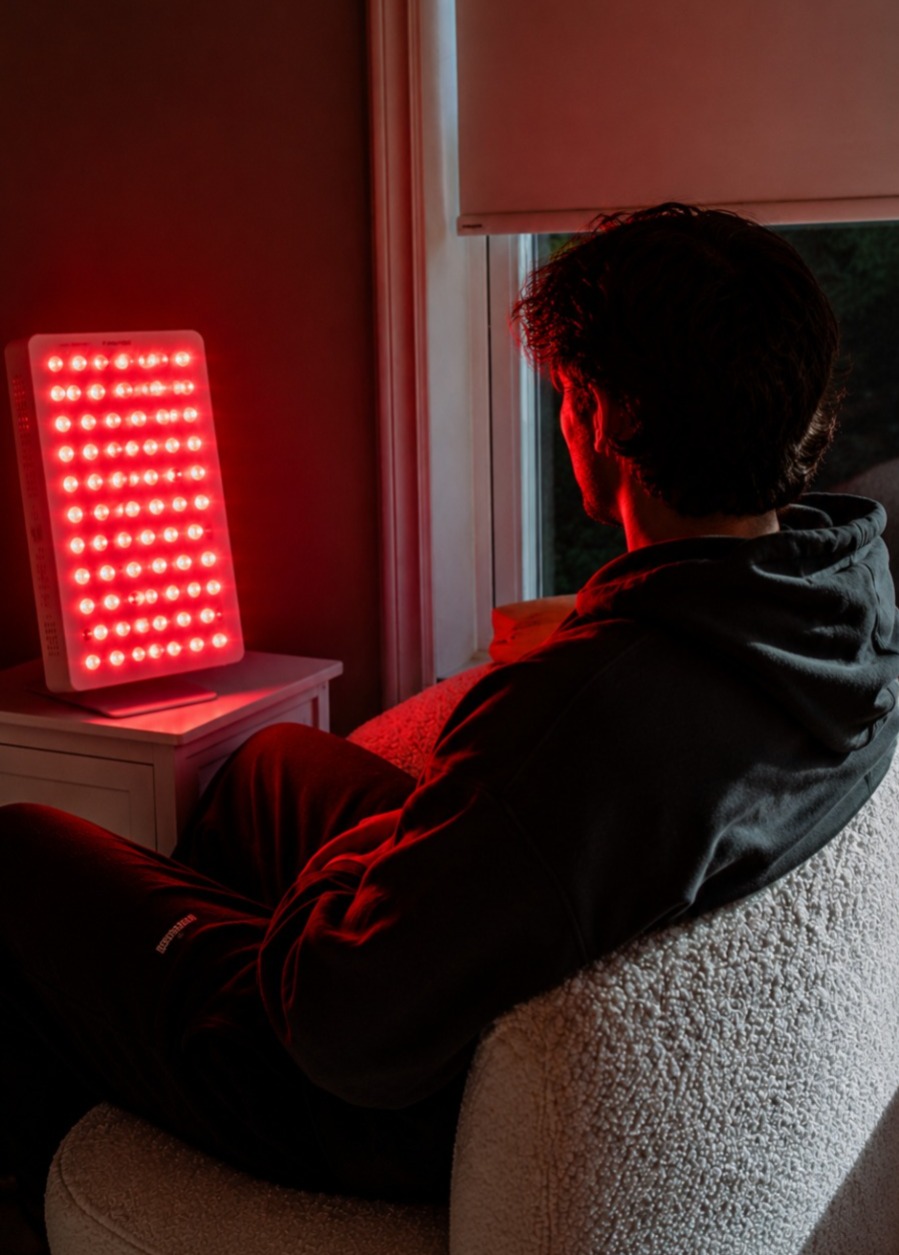
When you stand in front of a Rex panel, a cascade of biological events begins within seconds of photon absorption. Here is a step-by-step picture of what the research shows is happening:
- ●ATP production increases. Cytochrome c oxidase absorbs the incoming photons, the nitric oxide inhibition is relieved, and mitochondrial respiration accelerates. Cells in the treatment area produce more energy, which fuels repair, regeneration, and normal function.
- ●Reactive oxygen species are modulated. A transient, controlled rise in ROS acts as a signalling molecule, triggering antioxidant defences and switching on genes associated with cellular protection and repair — a process known as mitohormesis.
- ●Nitric oxide is released into the bloodstream. Once displaced from cytochrome c oxidase, nitric oxide diffuses into surrounding tissue and vasculature, causing blood vessels to dilate. Improved local circulation means more oxygen and nutrients delivered to recovering tissues.
- ●Pro-inflammatory cytokines are downregulated. Studies consistently show that red and near-infrared light reduce the expression of inflammatory markers such as TNF-alpha, IL-1β, and IL-6 — the same molecules targeted by many pharmaceutical anti-inflammatories, but without systemic side effects.
- ●Collagen and elastin synthesis is upregulated. Fibroblasts energised by the increased ATP output produce more structural proteins, gradually thickening and firming the dermis — the mechanism behind the skin rejuvenation results seen in dermatological studies.
- ●The nervous system responds. Near-infrared penetration at 810–850nm has been shown in neurological research to reach superficial brain tissue when applied to the skull, modulating neuronal activity and supporting the cognitive and mood-related benefits now being studied in clinical trials.
Evidence-Backed Benefits: What the Research Shows
The breadth of research on red light therapy is one of its most distinguishing features as a wellness technology. Unlike many biohacking trends that rest on preliminary or anecdotal evidence, photobiomodulation (the clinical term for red light therapy) has been studied in randomised controlled trials across a remarkably wide range of conditions. Here are the key benefit areas supported by published research:
- ●Muscle recovery and athletic performance. Multiple studies show that pre- and post-exercise red light therapy reduces markers of muscle damage, decreases delayed-onset muscle soreness (DOMS), and accelerates return to full performance — making it a legitimate tool for athletes training in Dubai's demanding climate.
- ●Inflammation and joint pain relief. Clinical trials in patients with osteoarthritis, rheumatoid arthritis, and chronic back pain demonstrate statistically significant pain reduction and improved mobility following regular photobiomodulation sessions.
- ●Skin health and anti-ageing. Dermatological research confirms increased collagen density, reduced fine lines, improved skin tone, and accelerated wound and scar healing — outcomes that make red light therapy a natural complement to aesthetic medicine practices across the GCC.
- ●Sleep quality. Research involving near-infrared light exposure has shown measurable improvements in melatonin production and sleep duration, a finding of particular relevance in a high-performance city where sleep deprivation is chronically underestimated as a health risk.
- ●Cognitive performance and mood. Emerging neurological research on transcranial photobiomodulation suggests improvements in executive function, memory, and mood, with early trials showing promise for stress-related cognitive decline.
- ●Wound healing and tissue repair. Among the most robustly studied applications, red light therapy has been shown to accelerate wound closure, reduce scarring, and improve healing outcomes across surgical, diabetic, and sports injury contexts.
How Red Light Therapy Works in a Practical Session
Understanding the biology is one thing; knowing what to expect in practice is another. A standard red light therapy session with a TWL Rex panel is straightforward, time-efficient, and entirely non-invasive. Most users see meaningful results with sessions of 10 to 20 minutes, three to five times per week, delivered consistently over four to eight weeks.
Distance from the panel matters. For most full-body benefits, positioning yourself 15 to 30 centimetres from the panel optimises irradiance — the amount of light energy delivered per square centimetre of tissue per second. The Rex panels are engineered to deliver therapeutic irradiance levels within this range, ensuring that sessions are both time-efficient and biologically effective.
Unlike UV-based therapies, red and near-infrared light carry no risk of DNA damage or sunburn. The sensation during a session is, at most, a gentle warmth — most users describe it as simply pleasant. There is no downtime, no recovery period, and no contraindication with most daily activities. The Rex panels also operate at 0 EMF emission, meaning there is no electromagnetic field exposure to consider for sensitive users or clinical environments.
Why Device Quality Determines Results
One of the most common reasons people don't experience the benefits documented in clinical research is that they are using underpowered or incorrectly specified devices. The studies that demonstrate measurable ATP increases, inflammation reduction, and collagen synthesis all use devices that deliver therapeutic irradiance at precisely calibrated wavelengths. A cheap panel bought online for a fraction of the price of a medical-grade device may emit broadly in the red spectrum without the optical precision required to actually drive photobiomodulation.
The TWL Rex range is built around medical-grade LEDs that are wavelength-verified to operate within the 630–670nm and 810–850nm therapeutic windows. They carry CE certification — the European standard for medical device safety and performance — and are supported by a Dubai-based team who can advise clinics, spas, gyms, and individual users on the correct panel selection and protocol design for their specific goals. For B2B clients across the UAE and GCC, dedicated pricing and installation support is available.
When you invest in a red light therapy panel, you are investing in a device that will be used hundreds of times over its lifespan. The cost-per-session economics of a high-quality home or clinic panel are, over time, vastly more favourable than ongoing treatment costs at a third-party facility — and the consistency of daily access is itself a therapeutic advantage, since protocol adherence is one of the strongest predictors of outcome in the published literature.
Frequently Asked Questions
How does red light therapy work at the cellular level?
Red light therapy works by delivering specific wavelengths of light — primarily 630–670nm (red) and 810–850nm (near-infrared) — to the mitochondria within your cells. These wavelengths are absorbed by an enzyme called cytochrome c oxidase, which is part of the mitochondrial electron transport chain. This absorption relieves inhibition caused by nitric oxide, allowing oxygen to bind properly and dramatically increasing ATP (cellular energy) production. The process also reduces harmful reactive oxygen species and triggers downstream repair and anti-inflammatory pathways throughout the body.
How long does it take to see results from red light therapy?
Most users begin to notice tangible improvements — such as reduced muscle soreness, improved skin texture, or better sleep — within two to four weeks of consistent use, typically three to five sessions per week of 10 to 20 minutes each. Cellular changes, including increased collagen production and reduced inflammatory markers, begin with the very first session, but the cumulative, visible effects build over four to eight weeks. Athletic recovery benefits are often felt most immediately, sometimes within 24 hours of the first few sessions.
Is red light therapy safe, and are there any side effects?
Red light therapy has an excellent safety profile and is considered non-invasive and non-ablative. Unlike UV light, the red and near-infrared wavelengths used in photobiomodulation do not carry enough energy to damage DNA or cause sunburn. Most users experience no side effects at all. Occasional mild, temporary effects such as slight skin redness or a feeling of fatigue after initial sessions are reported by a small number of users and typically resolve within hours. Those who are pregnant, on photosensitising medications, or have a history of light-sensitive conditions should consult a healthcare provider before beginning. The TWL Rex panels operate at 0 EMF, adding an additional layer of safety for regular use.
What is the difference between red light therapy and infrared saunas?
While both modalities use light-based energy, they work quite differently. Infrared saunas primarily use far-infrared wavelengths (above 1000nm) to generate heat within the body, and their benefits are largely heat-mediated — improving circulation, inducing sweating, and relaxing muscles. Red light therapy, by contrast, uses near-infrared wavelengths (810–850nm) and red wavelengths (630–670nm) that are absorbed directly by mitochondrial enzymes to drive cellular energy production. The process is non-thermal — no significant heat is generated in the tissue — and the biological mechanisms are fundamentally different. Red light therapy is also safe to use without any special environment or preparation, can be targeted to specific body areas, and produces none of the cardiovascular stress associated with sauna heat for sensitive individuals.
Experience the Science in Your Own Home or Clinic
The TWL Rex range brings CE-certified, medical-grade red light therapy to Dubai and across the GCC — with 0 EMF, dual-wavelength precision, and local expert support for homes, clinics, gyms, spas, and hotels.
Shop Rex Panels →Biology, optimized.
Our medical-grade photobiomodulation systems are engineered for the most discerning health optimizers in the UAE.