Red Light Masks Look Powerful. But Are They Delivering Enough Light?
Medically & Scientifically Verified: Evaluated against 660nm - 1060nm photobiomodulation standards for UAE clinical performance.
- 1.The Honest Starting Point
- 2.Masks can work. The problem is assuming every red glow delivers the same therapy.
- 3.The credible argument is not “masks do nothing.”
- 4.Irradiance Explained
- 5.Brightness is what your eyes notice. Irradiance is what the tissue receives.
- 6.What Published Numbers Show
- 7.Many masks sit in a lower irradiance range than high-output panels, although not every mask is low powered.
- 8.Where Masks Reach Their Limit
- 9.The failure is rarely the colour of the light. It is the restricted format.
- 10.Face-only coverage
- 11.Fixed geometry
- 12.Limited wavelength architecture
- 13.No distance control
- 14.Narrow use case
- 15.Comfort and hygiene
- 16.Mask
- 17.Targeted Panel
- 18.Wavelengths Matter Too
- 19.Higher irradiance cannot compensate for the wrong wavelength.
- 20.REX ULTRA
- 21.A panel-sized answer to the limitations of a mask.
- 22.Mask vs Panel
- 23.The better device depends on what you are actually trying to do.
- 24.The Most Important Correction
- 25.Do not buy a device based on irradiance alone.
- 26.At what distance?
- 27.Which wavelengths?
- 28.Peak or average?
- 29.What is the dose?
- 30.What is the use case?
- 31.Can the protocol be repeated?
- 32.Frequently Asked Questions
- 33.Sources and Further Reading
Red light masks have made photobiomodulation easier to understand and easier to try. They are wearable, visually striking and designed around one familiar promise: better-looking skin. Some are well engineered and supported by clinical data. But the format itself creates limitations that marketing photographs rarely explain.
The Honest Starting Point
Masks can work. The problem is assuming every red glow delivers the same therapy.
Home red light masks have grown rapidly in popularity, with claims focused on wrinkles, redness, acne and visible skin ageing. Dermatologists interviewed by The Guardian describe a plausible biological basis for red light interacting with skin and collagen, while also examining how strong the evidence is for consumer products.1
The research is not imaginary. A 2025 randomized, sham-controlled trial used a 660nm LED mask delivering 6.4 mW/cm² and 8.05 J/cm² over a 21-minute session. The study found improvements in some image-based wrinkle measurements and high participant satisfaction, although not every assessment method showed a significant difference.2
The credible argument is not “masks do nothing.”
It is that a mask is a narrow facial device. A high-output panel is a more adaptable light-delivery system. The distinction becomes clear when you examine irradiance, total dose, distance, wavelength range and treatment area together.
Irradiance Explained
Brightness is what your eyes notice. Irradiance is what the tissue receives.
Irradiance is the rate at which light energy reaches a surface. It is commonly expressed in milliwatts per square centimetre, or mW/cm². In practical terms, it tells you how much optical power is available at the skin during a session.
Irradiance matters because it influences how quickly a device can deliver a desired energy dose. But it is only one part of the equation. A lower-powered device can still deliver a meaningful dose if it is used for longer. A higher-powered device can reach the same dose more quickly, operate from a more comfortable distance, or cover a larger treatment area.
Example: 30 mW/cm² delivered for 10 minutes equals 18 J/cm². The correct dose depends on the target, wavelength, tissue, distance and protocol.
More irradiance is valuable because it creates dosing flexibility. It is not permission to use unlimited light. Photobiomodulation follows a dose response relationship
Photobiomodulation research repeatedly describes a biphasic dose response. Too little light may not create the intended effect, while excessive exposure can reduce the desired biological response. This is why “higher power” is useful only when it is paired with a defined protocol.3
What Published Numbers Show
Many masks sit in a lower irradiance range than high-output panels, although not every mask is low powered.
Consumer mask specifications vary widely. A mask used in a recent clinical trial operated at 6.4 mW/cm². CurrentBody lists 30 mW/cm² for its Series 2 mask. Solawave lists 65 mW/cm² for its higher-output Wrinkle Retreat Pro mask.245
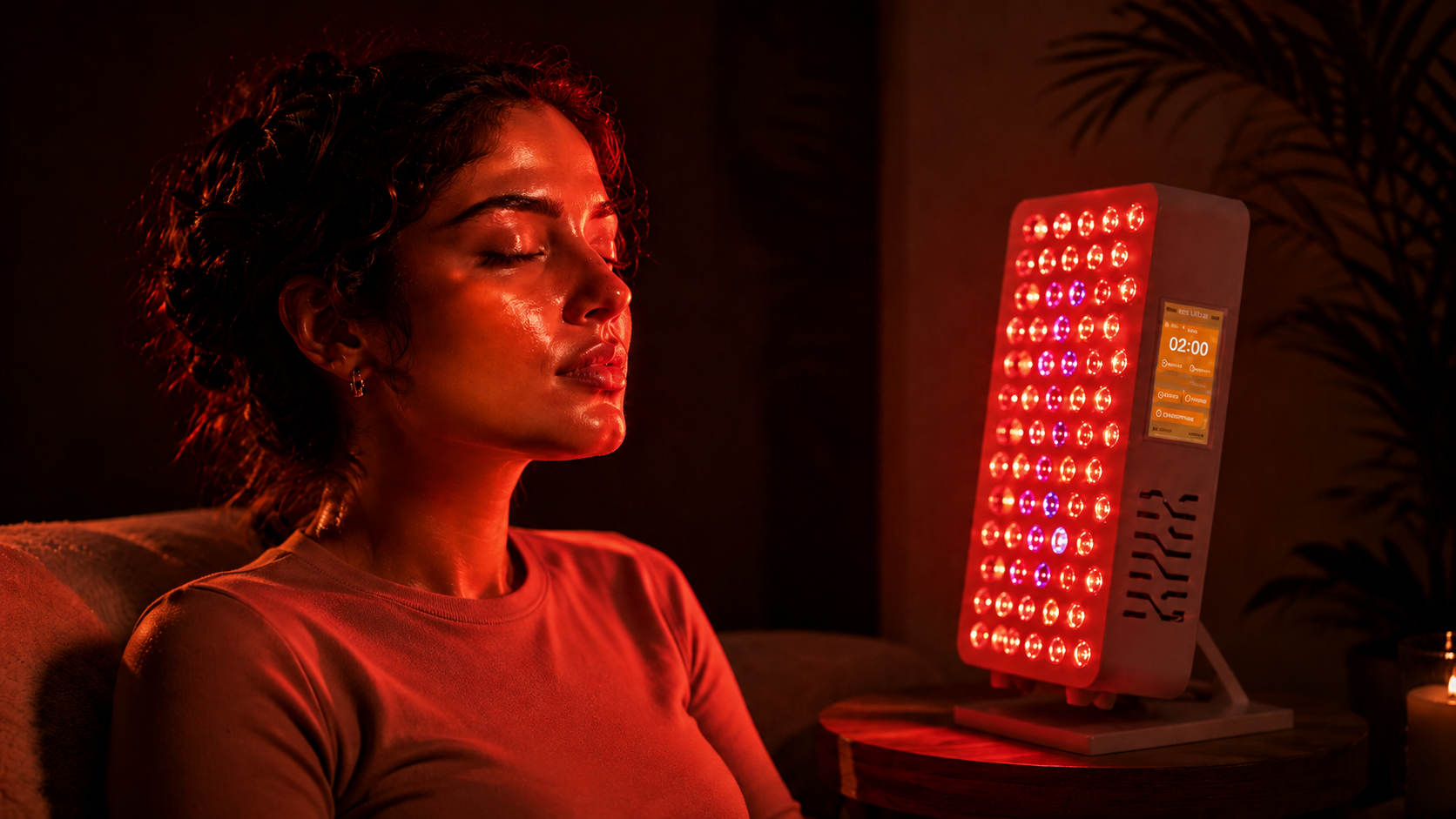
The REX ULTRA, previously referenced in some materials as REX PRIME, is a compact targeted panel rather than a wearable mask. Brand specifications position it in the 100+ mW/cm² high-output panel category at close working distance. Exact irradiance always changes with distance and measurement method, so comparisons should be made at matched distances using the same type of meter.
Values are shown to explain the scale of published specifications, not to prescribe treatment. Mask readings are manufacturer or study values. The REX figure must remain paired with the verified measurement distance in final technical documentation.
The advantage of a higher-output panel is therefore not simply “more energy.” It is the ability to deliver a useful dose with more control. You can adjust distance, shorten or extend the session according to the protocol, and direct the light toward areas that a face-shaped device cannot reach.
Where Masks Reach Their Limit
The failure is rarely the colour of the light. It is the restricted format.
Face-only coverage
A mask may cover most of the face, but it does not meaningfully serve the neck, scalp, shoulders, back, knees or larger muscle groups.
Fixed geometry
Every face has different contours. The nose, jawline, temples and eye openings can change the distance and angle between LEDs and skin.
Limited wavelength architecture
Many masks use two or three wavelengths selected mainly for cosmetic skin goals. A broader panel can support more varied protocols.
No distance control
A wearable mask fixes the device against or very close to the face. A panel lets the user change intensity by changing working distance.
Narrow use case
A mask is primarily a skincare purchase. A targeted panel can be repositioned for face, scalp, neck, joints and localized recovery routines.
Comfort and hygiene
Straps, pressure points, sweat and direct contact can affect consistency. A non-contact panel avoids wearing the device on the skin.
Mask
Convenient, hands-free and optimized for a single facial use case.
Targeted Panel
Adjustable positioning for the face, scalp, neck, shoulder, knee and other localized areas.
Wavelengths Matter Too
Higher irradiance cannot compensate for the wrong wavelength.
Light penetration is influenced primarily by wavelength and tissue optics, not by irradiance alone. Visible red wavelengths are commonly used for surface-level skin applications. Near-infrared wavelengths can travel farther through tissue and are frequently studied for deeper biological targets.
In the Huberman Lab discussion with Professor Glen Jeffery, long-wavelength red and near-infrared light are described as entering tissue, scattering and interacting with mitochondrial function. The episode also makes clear that the science of how different spectral patterns affect biology is still developing.6
Relative spectrum visualization only. Biological penetration is gradual, wavelength dependent and not represented as fixed depth boundaries.
The REX system combines 480, 630, 650, 660, 670, 810, 830, 850 and 1060nm wavelengths. That does not mean every wavelength should be used for every goal. It means the device can support more tailored presets than a mask built around one narrow cosmetic purpose.
REX ULTRA

A panel-sized answer to the limitations of a mask.
REX ULTRA is designed for localized sessions without restricting the user to the shape of a wearable device. Position it for the face, turn it toward the scalp, lower it toward the knee, or use it beside the shoulder. The same compact system can support multiple routines.
For someone interested only in a simple hands-free facial routine, a well-specified mask may be sufficient. For someone who wants greater output, adjustable distance, more wavelengths and the ability to use one device beyond the face, REX ULTRA is the more versatile format.
Mask vs Panel
The better device depends on what you are actually trying to do.
| Decision factor | LED face mask | REX ULTRA targeted panel |
|---|---|---|
| Primary purpose | Facial skincare convenience | Face plus localized recovery and wellness routines |
| Irradiance | Common published examples range from 6.4 to 65 mW/cm² | High-output panel category with adjustable working distance |
| Wavelengths | Often two to four wavelengths | Nine-wavelength architecture from 480 to 1060nm |
| Coverage | Face only, with fit-dependent edges and openings | Face, neck, scalp, shoulder, knee and other localized areas |
| Distance control | Fixed by mask design | Adjustable by repositioning the panel |
| Contact | Worn directly on or close to the skin | Non-contact use |
| Best choice for | Someone committed to facial use only | Someone seeking one compact device for multiple target areas |
The Most Important Correction
Do not buy a device based on irradiance alone.
A very high number without a stated distance is almost meaningless. Irradiance falls as the device moves away from the body. Meter type, beam angle, wavelength mix and whether the manufacturer reports peak or average output can also change the result.
Before comparing devices, ask five questions:
At what distance?
A reading at direct contact cannot be compared fairly with a panel measured from 15 or 30 centimetres away.
Which wavelengths?
Total irradiance may combine red, near infrared and other channels. The distribution matters.
Peak or average?
A single bright hotspot is not the same as uniform output across the treatment area.
What is the dose?
Power must be paired with session time to calculate the energy delivered per square centimetre.
What is the use case?
A facial anti-ageing protocol is not automatically appropriate for a knee, shoulder or muscle group.
Can the protocol be repeated?
The best device is one that can be used consistently, safely and according to clear instructions.
Frequently Asked Questions
Are red light masks a waste of money?
Not necessarily. Well-specified masks can deliver useful wavelengths and doses for facial skin. Their limitation is that they remain face-only devices with fixed geometry and limited flexibility.
Does more irradiance mean deeper penetration?
Not by itself. Wavelength has a major influence on tissue penetration. Higher irradiance increases the rate of energy delivery, while wavelength, tissue type and dose determine how the session behaves biologically.
Is 100+ mW/cm² automatically better than 30 mW/cm²?
No. It offers more dosing flexibility and can reduce the time needed to reach a target dose. The session still needs to follow a defined protocol because excessive exposure is not automatically more effective.
Why can a panel be more useful than a mask?
A panel can be repositioned, used without direct skin contact and applied to areas beyond the face. It can also provide adjustable intensity through distance control.
Can REX ULTRA be used only for the face?
No. It is a targeted panel designed for localized areas such as the face, scalp, neck, shoulder, knee and other smaller treatment zones, subject to the supplied protocol and safety guidance.
Who should seek medical advice before using a light device?
People with photosensitive conditions, eye concerns, pregnancy, active medical conditions, or medications that increase light sensitivity should speak with an appropriate healthcare professional and follow the device-specific contraindications.
Sources and Further Reading
- The Guardian Science Weekly, “Red-light masks: can they really slow ageing?”, 26 May 2026. View source
- Bragato EF et al. “Role of photobiomodulation application frequency in facial rejuvenation: randomized, sham-controlled, double-blind, clinical trial.” Lasers in Medical Science, 2025. View source
- Huang YY et al. “Biphasic Dose Response in Low Level Light Therapy.” Dose-Response, 2009. View source
- CurrentBody Skin LED Mask Series 2 product specifications: 30 mW/cm² power density and listed wavelengths. View source
- Solawave Wrinkle Retreat Pro product specifications: 65 mW/cm² irradiance and 11.7 J/cm² fluence over three minutes. View source
- Huberman Lab, “Using Red Light to Improve Metabolism & the Harmful Effects of LEDs,” with Professor Glen Jeffery, 1 December 2025. View source
- The Wellness Lab, REX ULTRA product page. View product
Biology, optimized.
Our medical-grade photobiomodulation systems are engineered for the most discerning health optimizers in the UAE.