Red Light Therapy for Neck Pain
Medically & Scientifically Verified: Evaluated against 660nm - 1060nm photobiomodulation standards for UAE clinical performance.
- 1.Why padel can trigger neck pain
- 2.Fast reactions, overhead tracking and fatigue can move more load into the neck and shoulders.
- 3.Repeated overhead tracking
- 4.Late contact and arm-dominant technique
- 5.Shoulder-blade fatigue
- 6.Sudden volume increases
- 7.Work posture before the match
- 8.Technique changes under fatigue
- 9.Soreness or something more?
- 10.Broad post-match tightness is different from sharp, radiating or neurological pain.
- 11.Seek urgent medical assessment when warning signs are present
- 12.What red light therapy does
- 13.Photobiomodulation delivers selected red and near-infrared wavelengths to influence cellular responses.
- 14.More power is not automatically better
- 15.What the research suggests
- 16.The evidence is promising for musculoskeletal pain and recovery, but it is not a universal cure for neck pain.
- 17.Chronic pain
- 18.Chronic neck pain
- 19.Musculoskeletal pain
- 20.Muscle recovery
- 21.A better padel recovery framework
- 22.Neck pain relief should not depend on one device.
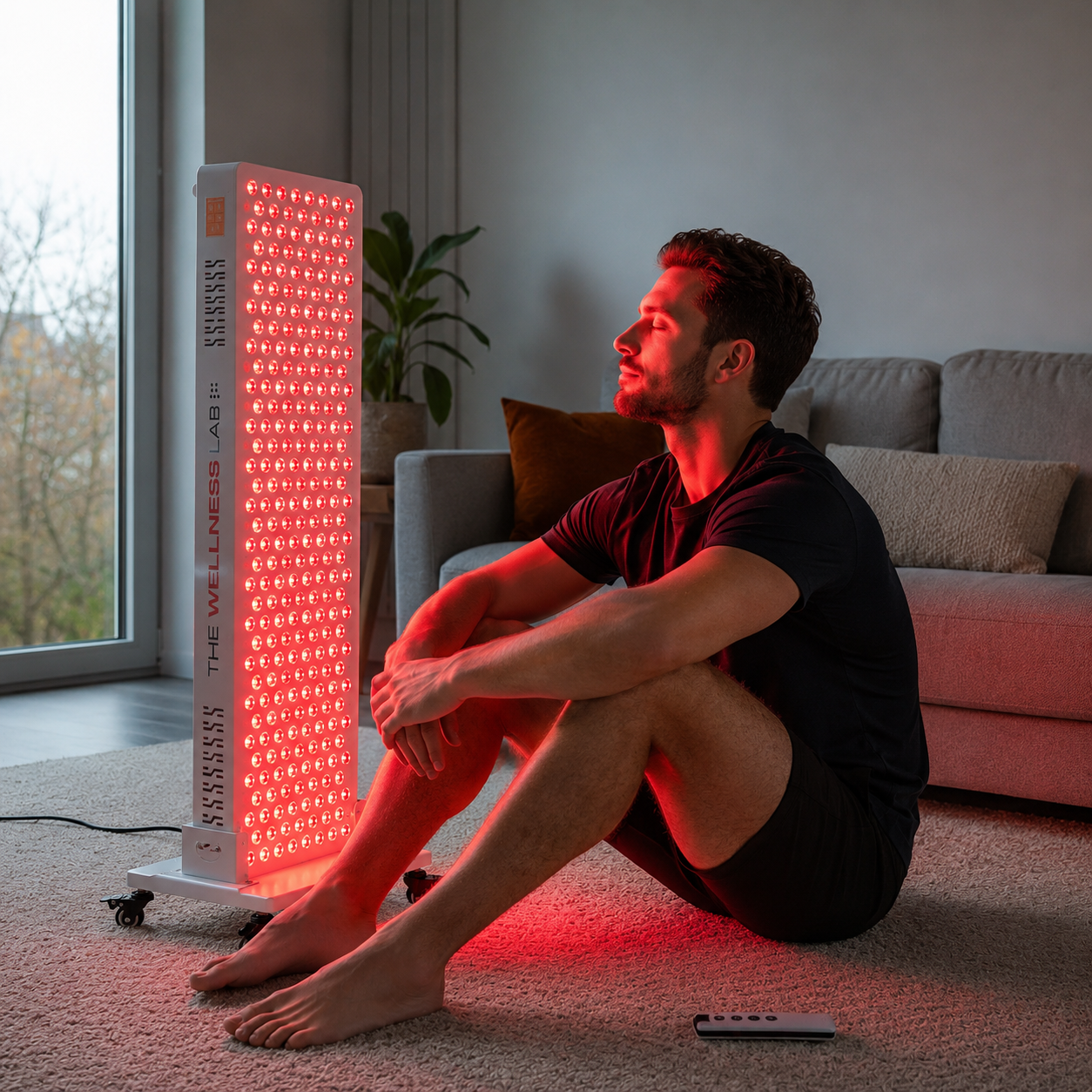
- 23.How to position a panel
- 24.Target the neck and upper-back region without forcing the head toward the light.
- 25.Which REX panel fits this use case?
- 26.Choose by treatment area, not by the largest panel available.
- 27.REX Ultra
- 28.REX Pro
- 29.What about REX Core and REX Prestige?
- 30.Before or after padel?
- 31.Use a familiar protocol and keep the recovery fundamentals in place.
- 32.Before padel
- 33.After padel
- 34.During active injury
- 35.For chronic pain
- 36.Frequently asked questions
- 37.Sources and further reading
- 38.Support your neck, shoulders and post-padel recovery.
Red Light Therapy for Neck Pain After Padel
Neck pain after padel may involve muscle fatigue, movement overload, poor recovery or a problem that needs professional assessment. Red light therapy may support pain relief, inflammation management and muscle recovery, but it should be used as part of a broader recovery plan rather than as a cure.

Neck pain rarely begins with one dramatic moment. For many padel players, it starts as tightness after a match, stiffness when turning the head, or a heavy upper trapezius that stays tense long after leaving the court.
Why padel can trigger neck pain
Fast reactions, overhead tracking and fatigue can move more load into the neck and shoulders.
Padel is fast, reactive and rotational. Players track the ball overhead, turn rapidly, reach outside a stable base and generate force through the shoulder and trunk. The neck, shoulder blades, rotator cuff, upper back and trunk must coordinate to keep the head stable while the arm accelerates.

Repeated overhead tracking
Looking upward for lobs and overhead shots repeatedly moves the neck through extension and rotation.
Late contact and arm-dominant technique
When the hips and trunk contribute less, the shoulder and upper body may absorb more of the workload.
Shoulder-blade fatigue
When the scapular muscles fatigue, the upper trapezius and surrounding neck muscles may compensate.
Sudden volume increases
Several matches after a period of limited activity may exceed the tissues' current capacity.
Work posture before the match
Long hours at a laptop or phone may leave the neck stiff before the first point is played.
Technique changes under fatigue
Poor timing, reduced trunk rotation and excessive shoulder elevation often appear late in a match.
Soreness or something more?
Broad post-match tightness is different from sharp, radiating or neurological pain.
Post-match muscle soreness often feels broad, heavy or tender and gradually improves with movement and recovery. A more significant neck problem may feel sharp, electric, radiating or progressively worse.
Seek urgent medical assessment when warning signs are present
- Sharp or electric pain
- Pain travelling into the arm or hand
- Numbness or tingling
- Arm or hand weakness
- Severe headache
- Dizziness or balance problems
- Pain following a fall or collision
- Loss of coordination
- New bowel or bladder symptoms
Red light therapy should never be used to delay medical evaluation when these symptoms are present.
What red light therapy does
Photobiomodulation delivers selected red and near-infrared wavelengths to influence cellular responses.
Red light therapy, also known as photobiomodulation or PBM, is a non-invasive application of visible red and near-infrared light. Research explores its interaction with mitochondrial activity, cellular signalling, circulation and inflammatory pathways.
More power is not automatically better
Photobiomodulation has a biphasic dose response. Too little exposure may be ineffective, while excessive exposure may reduce the desired biological response. Wavelength, distance, irradiance and treatment time must be considered together.
What the research suggests
The evidence is promising for musculoskeletal pain and recovery, but it is not a universal cure for neck pain.
Chronic pain
Systematic reviews suggest PBM may reduce pain and improve function in some chronic pain populations, although protocols and conditions vary substantially.
Chronic neck pain
A sham-controlled trial found that PBM alone did not significantly reduce resting neck pain, while combination treatment improved some movement-related outcomes.
Musculoskeletal pain
Athlete-focused reviews report potential pain reduction, but do not establish that PBM consistently shortens return-to-play time.
Muscle recovery
Meta-analyses report possible improvements in soreness, strength recovery and muscle-damage markers, with results dependent on dose and population.
Red light therapy may support pain management and recovery, but it should usually be considered an adjunct rather than the entire treatment plan.
A better padel recovery framework
Neck pain relief should not depend on one device.
- Reduce the aggravating load. Temporarily reduce the shots and movements that clearly increase symptoms.
- Restore comfortable movement. Use gentle neck, shoulder and upper-back movement without forcing sharp pain or tingling.
- Rebuild strength and endurance. Address deep neck flexors, scapular control, rotator cuff strength, thoracic mobility and trunk rotation.
- Improve match preparation. Warm up the upper back, shoulders, trunk and hips before moving into repeated overhead shots.
- Manage volume. Avoid sudden jumps from one casual match to several long sessions per week.
- Use recovery tools as support. PBM may complement movement, sleep, hydration, physiotherapy and appropriate medical care.
How to position a panel
Target the neck and upper-back region without forcing the head toward the light.
- Sit comfortably with the spine supported.
- Position the panel behind or slightly to the side of the neck.
- Keep the neck neutral instead of turning forcefully toward the panel.
- Expose the upper trapezius, back of the neck and shoulder-blade region as appropriate.
- Follow the distance and session duration supplied with the device.
- Do not extend the session simply because the area still feels tight.
Which REX panel fits this use case?
Choose by treatment area, not by the largest panel available.
Best for targeted neck and shoulder support
REX Ultra
Compact positioning for the neck, shoulder, elbow and other localised areas. Best suited to home users who want a focused recovery tool.
Best for wider upper-body recovery
REX Pro
A larger illuminated area for the upper back, both shoulders and broader post-padel recovery routines.
What about REX Core and REX Prestige?
They provide substantially larger coverage and may suit whole-body recovery, households or professional facilities. They are not necessary when the main goal is localised neck and shoulder support.
Before or after padel?
Use a familiar protocol and keep the recovery fundamentals in place.
Before padel
PBM should not replace a dynamic warm-up, shoulder activation or progressive practice swings.
After padel
A comfortable session may be used alongside hydration, food, sleep and gentle movement.
During active injury
Seek assessment when pain is sharp, persistent, worsening or associated with neurological symptoms.
For chronic pain
Use PBM as part of a wider plan involving exercise, workload changes, sleep and professional care.
Frequently asked questions
Can red light therapy cure neck pain?
No device can responsibly be described as a universal cure. PBM may support pain relief and recovery, but the cause of the pain still needs to be considered.
Can I use red light therapy immediately after padel?
It may be used after exercise when permitted by the device instructions and when no contraindications are present.
Is red light therapy better than stretching?
They serve different purposes. PBM is a passive modality, while mobility and strengthening address movement and capacity.
Should I play padel with neck pain?
Mild stiffness is different from sharp, radiating or worsening pain. Stop and seek assessment when strength, sensation, coordination or balance are affected.
Which wavelengths are commonly used for muscle recovery?
Red and near-infrared wavelengths are both used in PBM research. The complete dose matters more than wavelength alone.
Sources and further reading
- Systematic review of padel injuries and common musculoskeletal complaints.
- Research on shoulder biomechanics and muscle activation during padel strokes.
- Systematic reviews of photobiomodulation for chronic pain and musculoskeletal recovery.
- Randomised trial evaluating PBM and electrical stimulation in chronic neck pain.
- Meta-analyses of PBM for athlete pain, soreness and muscle recovery.
Support your neck, shoulders and post-padel recovery.
Explore targeted nine-wavelength red light therapy panels designed for focused and wider upper-body recovery routines.
Explore REX Recovery PanelsBiology, optimized.
Our medical-grade photobiomodulation systems are engineered for the most discerning health optimizers in the UAE.