Red Light Therapy for Post Workout Recovery: A Smarter Recovery Routine
Medically & Scientifically Verified: Evaluated against 660nm - 1060nm photobiomodulation standards for UAE clinical performance.
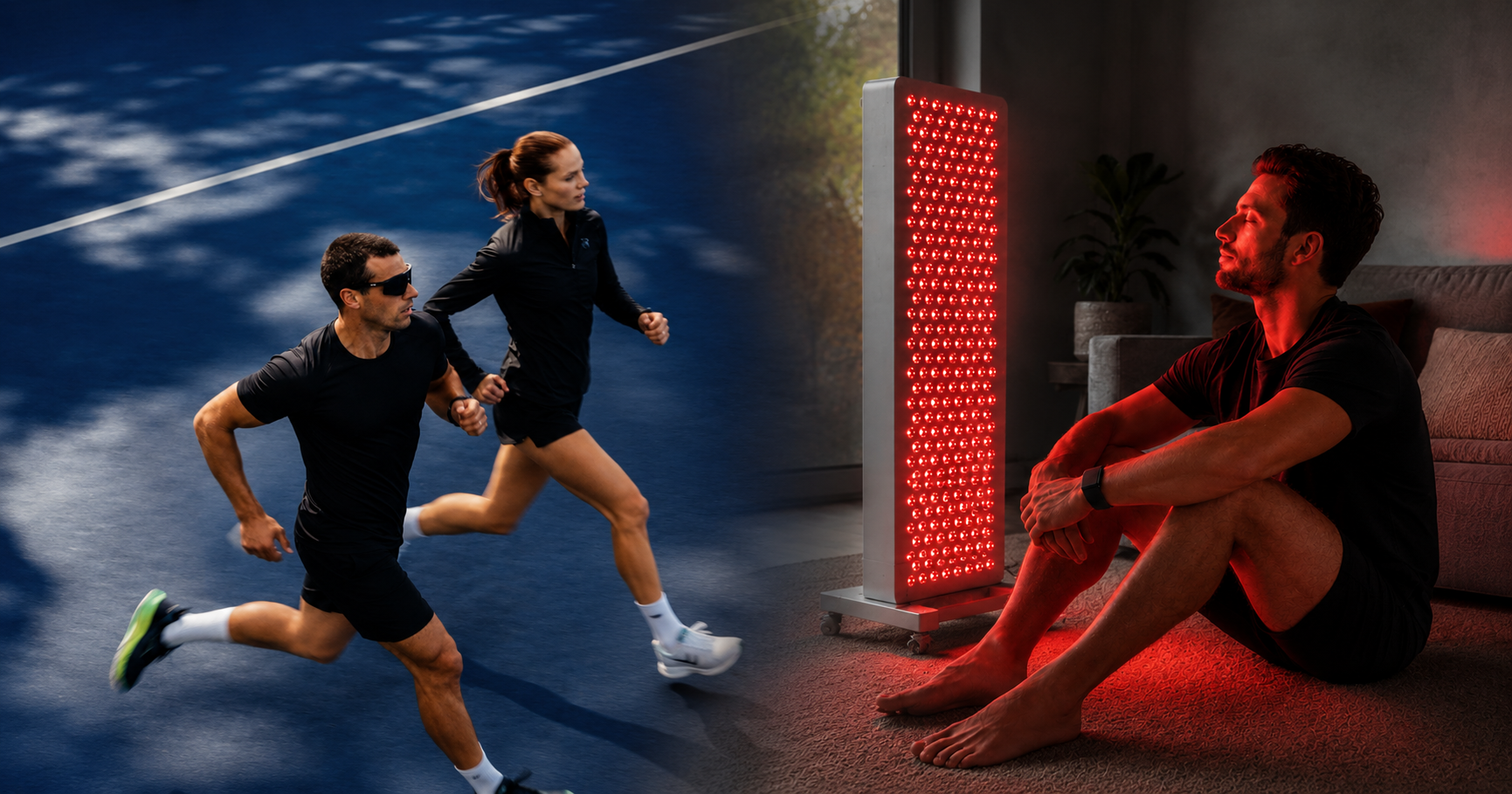
- 1.The workout ends. The adaptation begins.
- 2.Technology works best when the basics are already in place.
- 3.Rehydrate
- 4.Refuel
- 5.Keep moving
- 6.Prioritise sleep
- 7.Photobiomodulation is being studied for muscle soreness, performance and recovery.
- 8.Recovery scores are measurements, not interventions.
- 9.Not every recovery session needs a full body setup.
- 10.Keep it targeted, repeatable and within the recommended protocol.
- 11.Bring targeted recovery into your post workout routine.
Red Light Therapy for Post Workout Recovery: A Smarter Recovery Routine
Training creates the stimulus. Recovery determines how ready your body is for the next run, gym session, padel match or training day. Here is how red light therapy can fit into a complete post workout recovery routine without replacing the fundamentals.
The workout ends. The adaptation begins.
Muscle soreness is often treated as the signal that recovery needs to begin. In reality, recovery starts as soon as the training stimulus ends. Exercise places mechanical and metabolic stress on muscle tissue and can temporarily reduce force production, increase fatigue and contribute to delayed onset muscle soreness.
A useful post workout recovery routine should therefore ask a better question than “What can I do when I hurt?” The better question is: “What can I do consistently after training to support the next session?”
Technology works best when the basics are already in place.
Rehydrate
Replace fluids lost during exercise, especially when training in hot environments such as the UAE.
Refuel
Protein supports muscle protein synthesis while carbohydrates help replenish glycogen used during training.
Keep moving
Light walking and comfortable mobility can help reduce stiffness without adding unnecessary training load.
Prioritise sleep
No recovery device compensates for consistently poor sleep. Sleep remains one of the foundations of recovery.
Photobiomodulation is being studied for muscle soreness, performance and recovery.
Red light therapy, also called photobiomodulation or PBM, uses selected red and near infrared wavelengths. Research has explored its effects on cellular metabolism, mitochondrial signalling, inflammatory pathways and exercise recovery.
A 2024 meta analysis of 34 randomised controlled trials reported improvements in muscle endurance and some measures of strength recovery and muscle-damage markers after pre exercise PBM, although results differed across participant groups.
A 2025 systematic review and meta analysis reported low certainty evidence that PBM applied before exercise reduced muscle soreness and improved performance 24 hours after exercise induced muscle damage.
Recovery scores are measurements, not interventions.
WHOOP, Garmin, Oura and similar wearables can help users notice patterns between training load, sleep, resting heart rate, HRV and perceived fatigue. But a recovery score does not create recovery. It only gives context.
If your score drops, the useful question is not simply “How do I make the number green again?” It is “What behaviour caused the drop?” Poor sleep, travel, dehydration, training volume, alcohol and stacked training sessions can all influence readiness.
Not every recovery session needs a full body setup.
A runner may want to focus on calves, quadriceps or hamstrings. A strength athlete may prioritise shoulders, back or glutes. A padel player may focus on forearms, shoulders or calves.
A compact panel can be repositioned around those areas without requiring an entire dedicated recovery room. This is where REX Ultra fits particularly well.
Keep it targeted, repeatable and within the recommended protocol.
Identify the highest load area. After a run that may be the calves or quadriceps. After padel it may be the shoulder or forearm.
Position the panel comfortably. Current REX Ultra guidance recommends approximately 15 to 45 cm from the treatment area.
Use the appropriate preset. REX Ultra includes seven preset modes, including a Muscle mode designed to simplify targeted use.
Stay within the recommended session window. Current guidance recommends approximately 10 to 20 minutes per treatment area.
Do not chase maximum intensity. PBM is dose dependent. More exposure is not automatically better.
Build it into an existing habit. Workout, shower, meal, recovery session is easier to repeat than creating a separate ritual.
Is red light therapy good for post workout recovery?
Research suggests PBM may support certain aspects of muscle recovery, soreness and strength recovery. Results vary by protocol, timing, dose and individual factors.
Should I use red light therapy before or after a workout?
Research has studied both approaches, although a substantial portion of exercise PBM research has focused on pre exercise use. Follow the device-specific protocol rather than assume one timing strategy fits everyone.
How long should I use REX Ultra?
Current product guidance recommends approximately 10 to 20 minutes per treatment area.
How far should REX Ultra be from the body?
Current guidance recommends approximately 15 to 45 cm from the treatment area.
Does more red light mean better recovery?
No. Wavelength, irradiance, treatment time and total dose matter together. More exposure is not automatically more effective.
- PubMed, meta analysis of pre exercise photobiomodulation and muscle recovery, 2024.
- PubMed, systematic review and meta analysis of PBM for muscle recovery, 2025.
- The Wellness Lab, current REX Ultra product guidance and protocol information.
Bring targeted recovery into your post workout routine.
Explore REX Ultra, the compact nine wavelength red light therapy panel designed for flexible targeted use at home.
Explore REX UltraBiology, optimized.
Our medical-grade photobiomodulation systems are engineered for the most discerning health optimizers in the UAE.