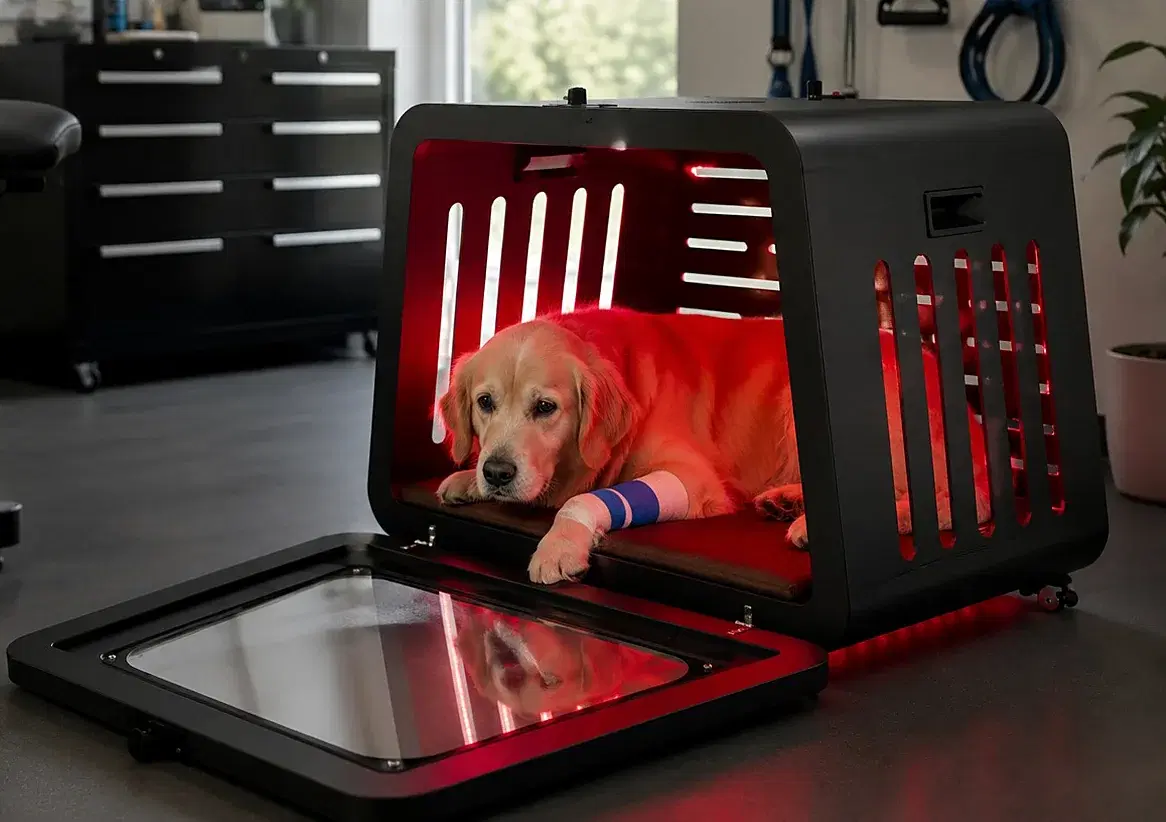
Red light therapy may help dogs with joint stiffness, but the evidence is early. In a 2022 randomised trial of 20 dogs with hip osteoarthritis, a vet laser course over 3 weeks lowered pain scores more than a common anti-inflammatory for the first month.
A 2023 review of 45 animal studies still called the overall evidence low in quality. So start with your vet, and if they agree, REX PET POD (AED 6,999) brings red and near-infrared light home in 10 to 12 minute sessions.
Hip osteoarthritis, 2022 trial
Followed up to 90 days
Dogs, cats and horses, 2023 review
Overall, per the 2023 review
Does red light therapy work for dogs?
For joint stiffness in older dogs, early trials are encouraging. Across other uses, the research is thin and mixed. Vets call it photobiomodulation, and here is what the newest studies found.
20 dogs (40 hips) with hip osteoarthritis, double blinded
A 3 week vet laser course beat 21 days of meloxicam on several pain and function scores at 8, 15 and 30 days. Hip range of motion improved from day 15 to day 90.
Small trial30 dogs with hip osteoarthritis, three groups of 10
Laser alone, joint injections alone and both together all improved scores against baseline. The combination gave the largest and longest lasting change. There was no group without any therapy to compare against.
Preliminary45 studies: 24 in dogs, 1 in cats, 20 in horses
A general lack of quality evidence, with too little support for most uses. Results varied with wavelength, laser class, dose and session frequency.
Low quality overallPut simply: the dog trials are small, the two newest come from the same research group, and both focus on hip osteoarthritis. Read the results as promising, not proven, and expect your dog's response to be its own.
What red light therapy can't do for your dog
It is a support, not a shortcut. Four things to keep in mind.
Limping has many causes. A diagnosis comes first, and so does the pain plan your vet sets.
The 2022 trial compared laser with meloxicam under vet supervision. It is not a reason to change your dog's medicine without your vet.
The trials measured pain scores, movement and owner ratings, not cartilage or joint structure.
The 2022 dog trial used a Class IV veterinary laser at doses set by researchers. Its results don't transfer automatically to any home device, REX PET POD included.
Vet laser or home pod: what's the difference?
The light source and who controls the dose. A clinic laser is aimed at one joint by a trained team. A home pod bathes the whole dog in LED light, so you can keep sessions regular between vet visits.
| Dogs in the 2022 trial | REX PET POD at home | |
|---|---|---|
| Light source | Class IV veterinary laser | 120 LEDs in a roof panel and a floor panel |
| Wavelengths | Set by the study protocol | 630 and 660 nm red; 810, 830 and 850 nm near-infrared |
| Who sets the routine | The research vet team | You, agreed with your vet |
| Area covered | The affected joint | The whole dog, from above and below |
Sharing a wavelength with a study doesn't mean matching its result: power, distance and session time decide how much light reaches the tissue. Our guide to irradiance, distance and dose explains how to compare devices.
How to use red light therapy on your dog at home
Vet first, then short, calm and regular sessions, with you in the room the whole time.
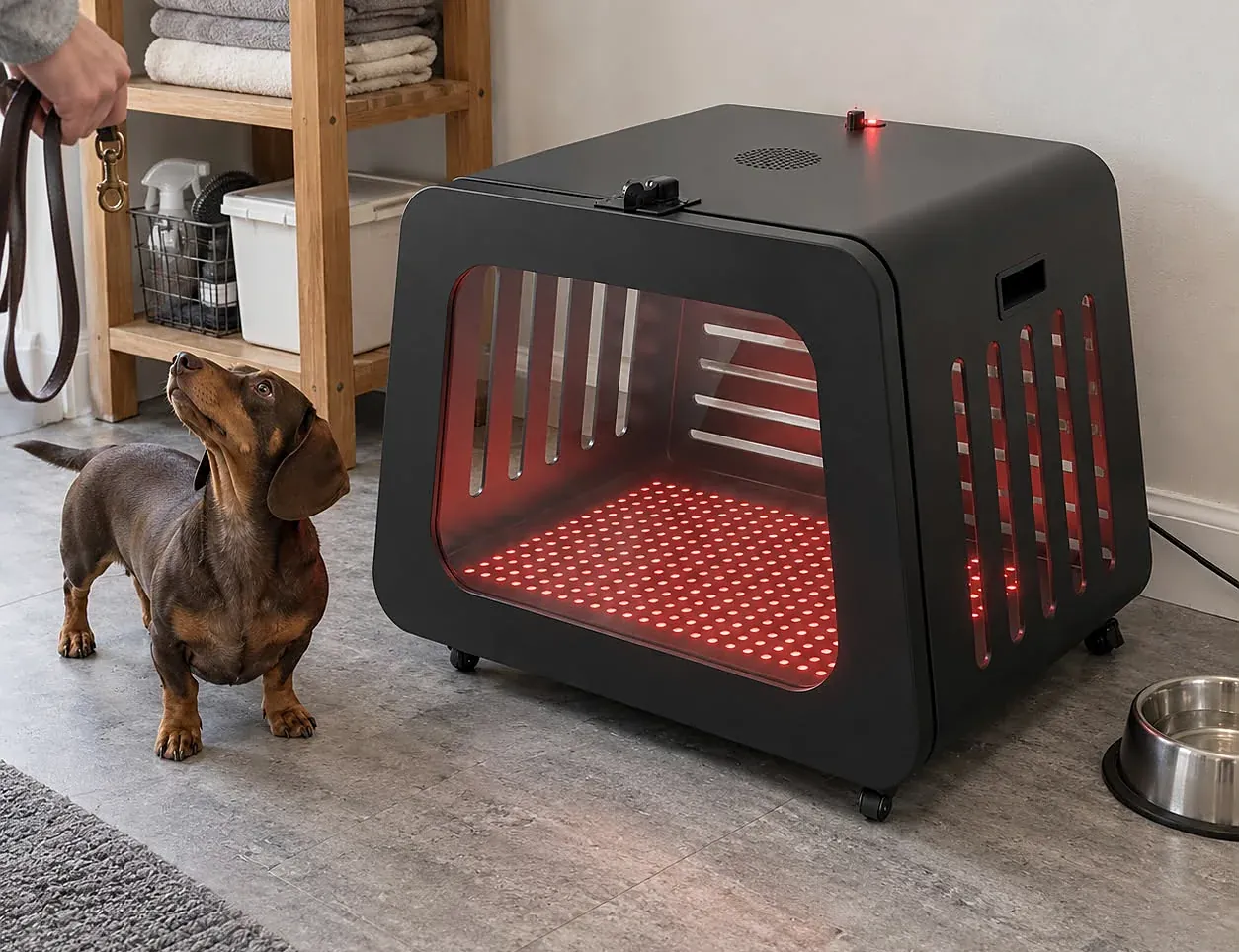
- 01Talk to your vetGet a diagnosis and ask whether light sessions fit your dog's plan, especially after surgery or with an eye or health condition.
- 02Introduce the pod slowlyLet your dog sniff and walk in while it is switched off, so it becomes a calm, familiar space.
- 03Settle them inMake sure your dog is clean, dry and calm, then close the glass door.
- 04Run a 10 to 12 minute sessionFollow the REX PET POD instructions, and let your vet decide how many sessions a week suit your dog.
- 05Stay with themNever leave your dog alone during a session, and stop if they seem distressed or too warm.
- 06Track how they moveOnce a week, note how your dog gets up, climbs stairs and walks. Share it at vet check-ins, alongside weight and exercise goals.
Which REX is right for your dog?
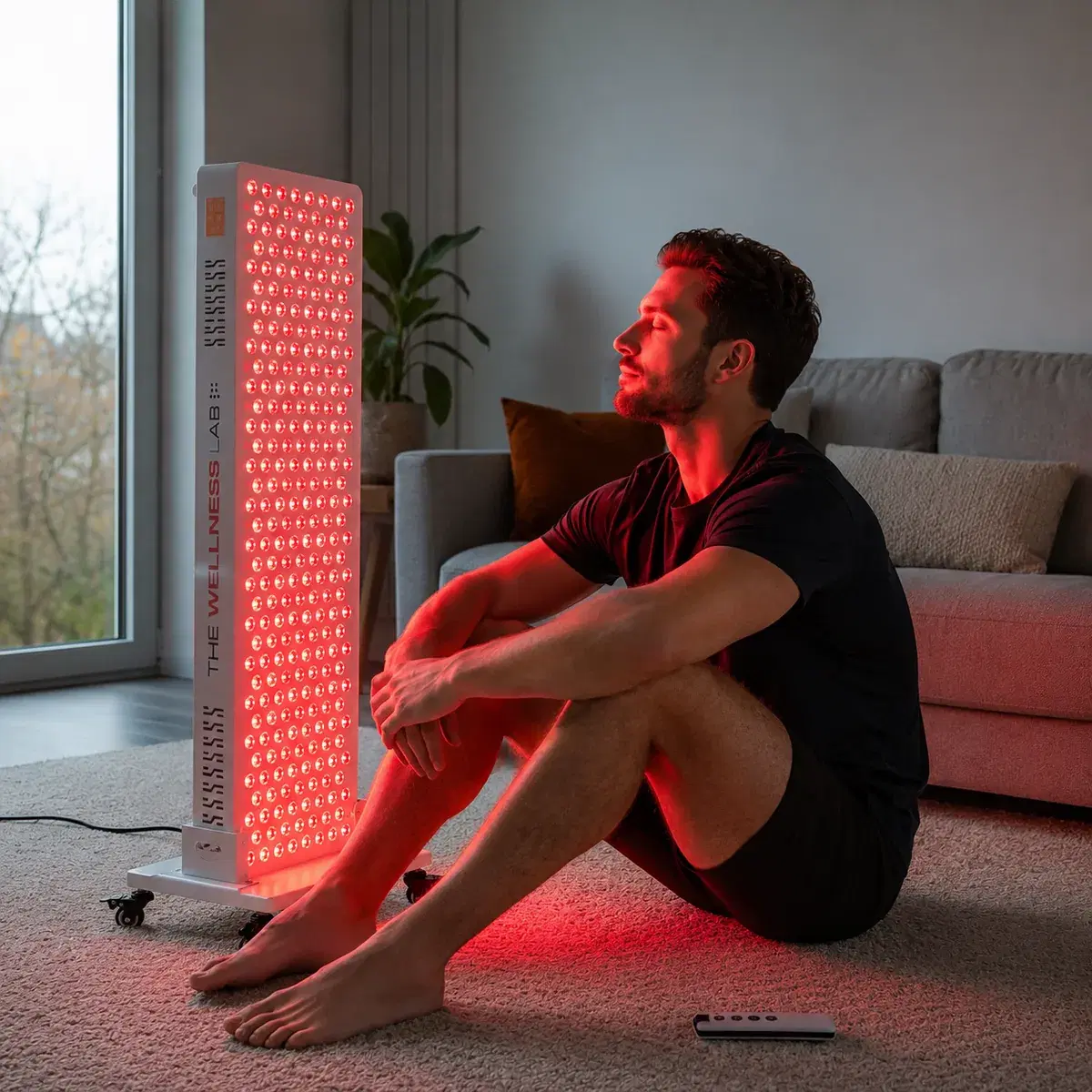
REX PET POD is built for pets. Our people panels, like REX PRO, are designed for humans, so keep them for yourself unless your vet says otherwise.
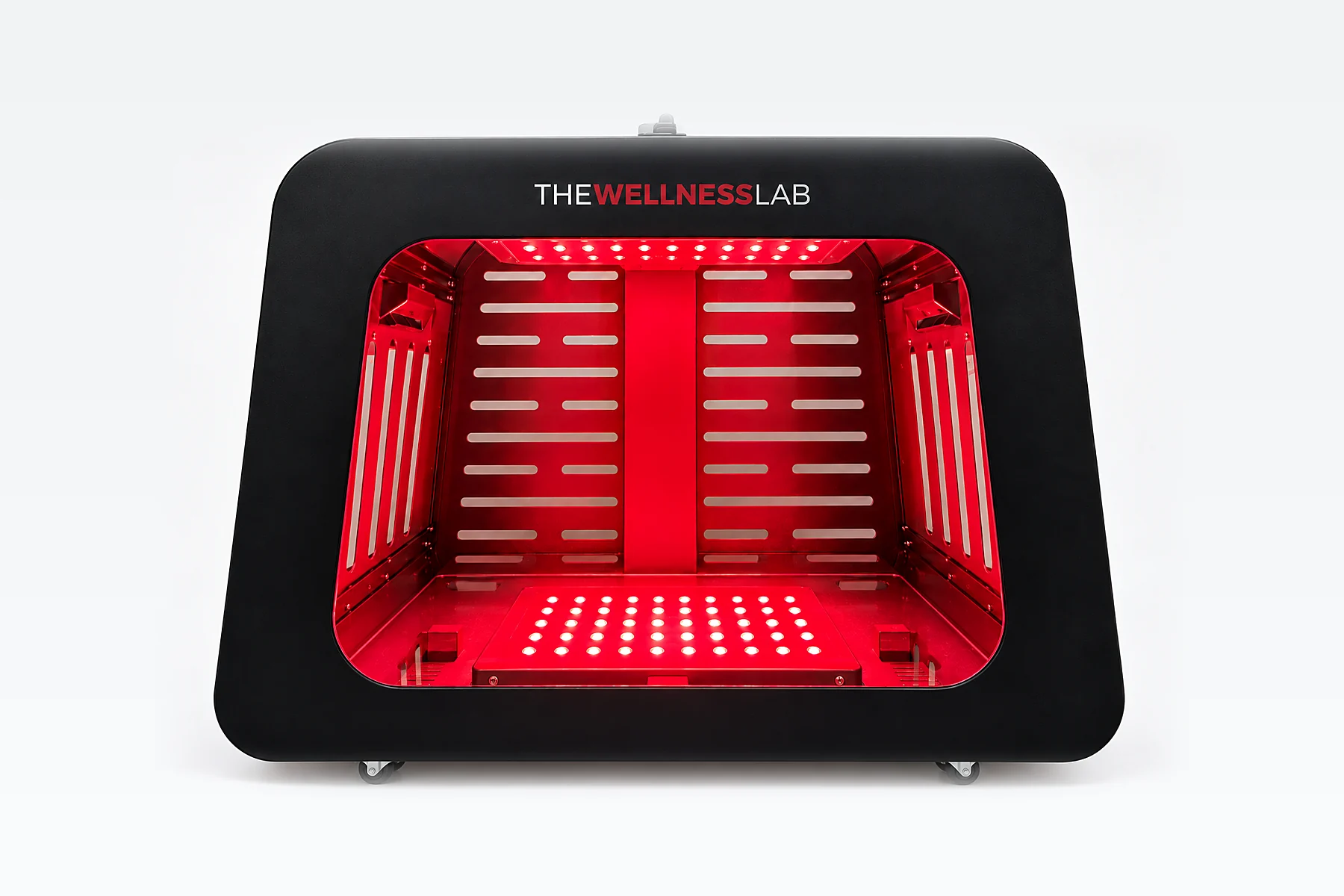
120 LEDs, 5 wavelengths from 630 to 850 nm, 60 x 45 x 50 cm
For small to medium dogs that can sit and turn around inside, and for cats.
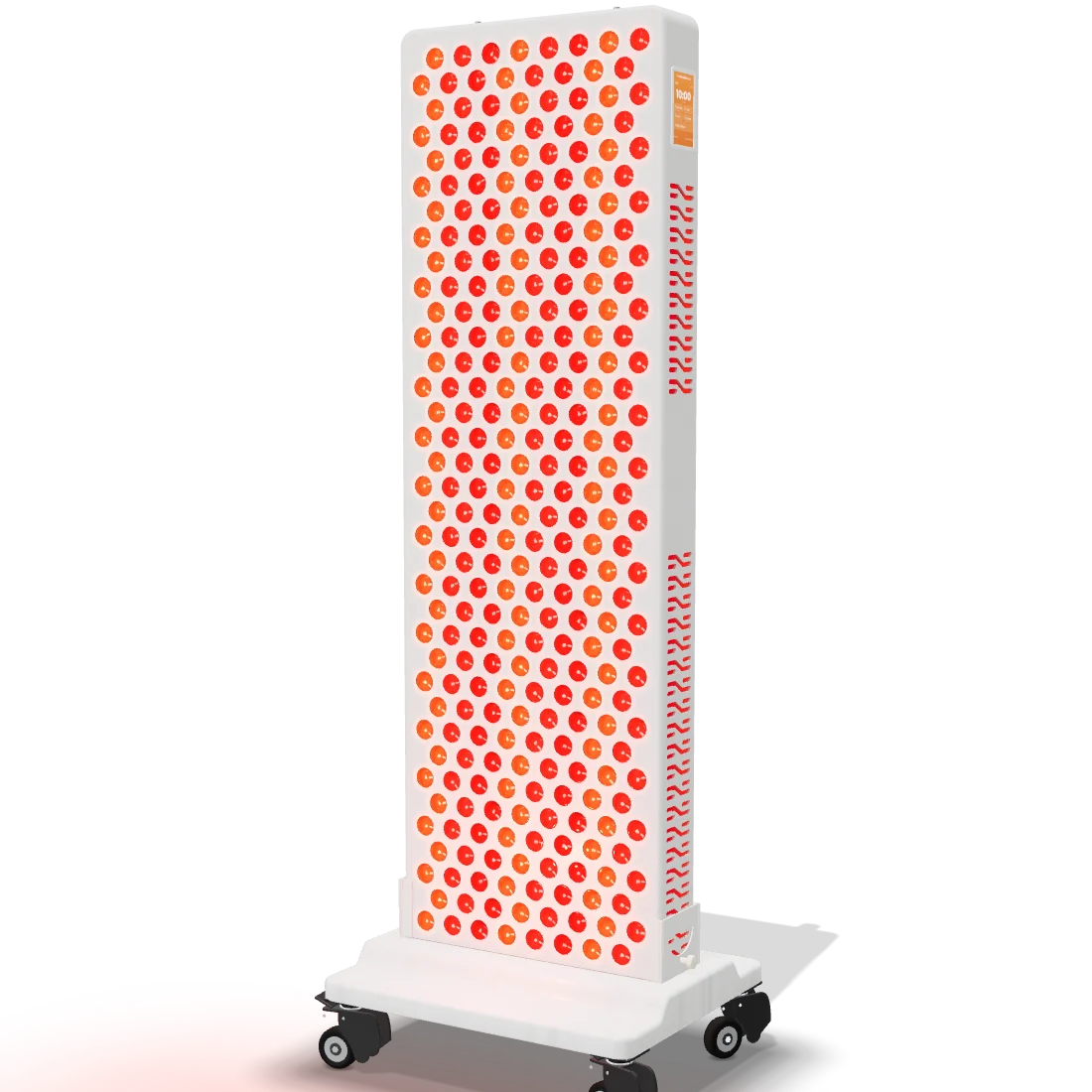
288 LEDs, 9 wavelengths, wheeled floor stand
Your own recovery routine: twice a day, 15 to 25 minutes, goggles included.
Delivery is free across the UAE, and our team sets it up for you. Not sure what fits? Take the product quiz or book a 15-minute demo on WhatsApp: +971 58 586 5195.
When should your dog see the vet first?
Always before you start, and straight away if:
- !the limp started suddenly, or your dog won't put weight on a leg
- !a joint is swollen, hot or painful to touch
- !your dog has had recent surgery, a wound or an eye condition
- !they are off their food, unusually quiet or getting worse
Read our guide on whether red light therapy is safe for the eye and skin precautions that apply to everyone in the house.
Frequently asked questions
Is red light therapy safe for dogs?
Light sessions are non-invasive, but safe use still depends on the device and the dog: check with your vet first, stay with your dog the whole session and stop if they seem distressed.
How long until I see a difference in my dog?
In the 2022 trial, pain scores improved within 8 to 30 days and range of motion was still better at 90 days. Every dog responds differently, so keep sessions regular for several weeks and ask your vet what to expect.
Can it replace my dog's arthritis medication?
No. One small trial compared a vet laser with meloxicam, but that doesn't make light a substitute. Never change your dog's medicine without your vet.
Can I use my own red light panel on my dog?
REX panels for people are designed for human use, so we don't advise it without your vet's agreement. REX PET POD is built for pets, with an enclosed space and 10 to 12 minute sessions.
Will my dog fit in REX PET POD?
It suits small to medium dogs. Your dog should be able to sit and turn around inside. Outside, it measures 60 x 45 x 50 cm.
Does red light therapy work for cats too?
REX PET POD is made for cats as well as dogs, but the research on cats is very limited: the 2023 review found just one cat study. Ask your vet before you start.
A promising extra for stiff joints, always with your vet
Small trials in dogs with hip osteoarthritis are encouraging, the wider evidence is low in quality, and your vet's plan comes first. If they agree, REX PET POD makes regular sessions easy at home.
Shop REX PET POD Compare REX WhatsApp demoSources
- Alves JC, et al. American Journal of Veterinary Research, 2022; 83(8). A randomized double-blinded controlled trial on the effects of photobiomodulation therapy in dogs with osteoarthritis. doi.org/10.2460/ajvr.22.03.0036
- Alves JC, et al. Animals, 2023; 13(20): 3247. Platelet-rich plasma and photobiomodulation in canine osteoarthritis, a preliminary report. doi.org/10.3390/ani13203247
- Millis DL, Bergh A. Animals, 2023; 13(4): 667. A systematic literature review of complementary and alternative veterinary medicine: laser therapy. doi.org/10.3390/ani13040667